


Every release wave creates the same kind of noise.
A long list of updates appears. Product teams start scanning feature pages. Internal conversations jump quickly to “What’s new?” But for most organizations, that is not the right first question.
The better question is this: what should we prioritize first so that the release creates business value instead of review fatigue?
Microsoft made the Dynamics 365 2026 Release Wave 1 plans available on March 18, 2026, with production rollout beginning on April 1, 2026. This wave covers features planned from April through September 2026, and Microsoft notes that the release plan is updated weekly and that planned functionality can still change.
That matters because a release wave is not just a product update. It is an operating decision.
If your team treats the wave like a checklist, you will spend time reviewing features that have little practical effect. If you treat it like a prioritization exercise, you can focus on the changes that affect adoption, process quality, governance, and business outcomes.
What the 2026 release wave 1 actually signals
This release wave spans a wide part of the Dynamics 365 portfolio, including Sales, Customer Service, Contact Center, Field Service, Finance, Supply Chain Management, Project Operations, Commerce, Human Resources, Customer Insights, and Business Central. Microsoft describes it as a release with hundreds of new features across these applications.
But volume is not the signal.
The signal is where Microsoft is placing its weight. Across the official overview pages, the direction is clear: more Copilot experiences, more AI-assisted workflows, more agentic capabilities, stronger cross-application intelligence, and more emphasis on turning systems from places where data is stored into places where action gets guided. Sales, for example, is positioned as moving from a system of record to a system of action. Customer Service is extending agentic workflows and supervisor tooling. Supply Chain Management is adding more intelligence around planning, suppliers, and warehouses. Business Central is pushing further toward AI-driven ERP and autonomous business processes.
So the real planning task is not “Which features are new?” It is “Which changes will affect how our teams work, decide, and operate?”
Why many teams prioritize the wave the wrong way
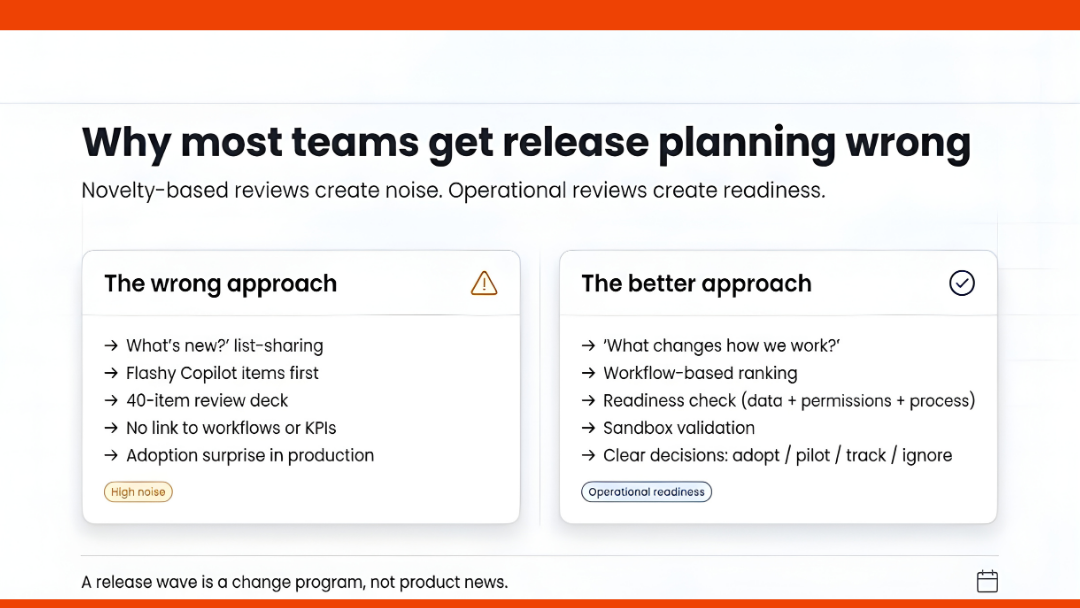
A common mistake is to prioritize based on novelty.
The newest Copilot feature gets attention. A flashy UI improvement becomes the center of the internal review. A long list of “interesting” items gets circulated. Then the team loses momentum because nobody has tied those updates back to live processes, user groups, or business KPIs.
That approach creates two problems.
First, it pulls attention away from features that may be automatically enabled or that may quietly affect day-to-day workflows.
Second, it confuses product awareness with operational readiness.
A release wave should not be reviewed like product news. It should be reviewed like a change program.
A practical way to prioritize Dynamics 365 release wave 1 2026
1) Start with what could affect users without much friction
Microsoft now clearly labels how features are enabled in customer environments. Some experiences are enabled automatically for users. Some are enabled automatically for admins, makers, or analysts. Others must be turned on or configured before users see them. That enablement model is one of the first things to review because it tells you where change may arrive with minimal intervention and where your team has more control over timing.
This is the first filter because it helps answer a practical question:
Could this change touch users before we have fully socialized it internally?
If the answer is yes, that feature deserves earlier attention.
2) Prioritize by business workflow, not by product page order
The smartest way to review the wave is by workflow:
- revenue generation
- service delivery
- operations and supply planning
- finance and back office
- field execution
- partner or customer engagement
That matters because Microsoft’s own release direction differs by workload.
In Dynamics 365 Sales, the emphasis is on AI, autonomous agents, pipeline enrichment, prioritization of actions, and research-led selling.
In Dynamics 365 Customer Service, the emphasis is on agentic service orchestration, richer Copilot integration, knowledge, quality, and supervisor visibility.
In Dynamics 365 Supply Chain Management, the emphasis is on smarter demand planning, protected capable-to-promise dates, supplier communication, supplier engagement, and more intelligent warehouse operations.
In Business Central, the emphasis is on AI-powered agents, finance automation, document interpretation, approvals, manufacturing and supply chain scenarios, and continued developer productivity improvements.
That means your first prioritization question should be:
Which workflow creates the highest near-term operational value for us if improved first?
Not every organization needs to start in the same place.
3) Treat AI-heavy updates as readiness questions, not just feature questions
This wave carries a strong AI direction across the portfolio. That creates upside, but it also raises a more serious readiness issue.
If a feature depends on good records, usable permissions, structured knowledge, and reliable process discipline, then the real blocker may not be the feature itself. It may be the condition of your data and process foundation.
This is partly an inference from Microsoft’s direction: where Sales depends on enriched signals and contextual action, where Customer Service leans on knowledge and intent, and where Business Central is using agents for more end-to-end business processes, weak master data, fragmented ownership, and inconsistent governance will reduce the value you get from the release.
So when you review the wave, do not only ask:
- Is this feature available?
- Is this feature useful?
Also ask:
- Is our data good enough for it?
- Are our permissions ready?
- Do we trust the process this feature will sit inside?
4) Use sandbox validation as part of prioritization
Microsoft’s release schedule guidance is clear that customers can use early access to validate updates in sandbox before the production update is applied. Microsoft also reiterates that release timing can vary by region and that the release plan itself may change.
That means the release wave should be treated as a staged assessment:
- identify candidate features
- shortlist by business impact
- validate in sandbox
- decide what to adopt, defer, govern, or communicate
This is especially important for workflows where automation, routing, approvals, or end-user prompts could influence real transaction behavior.
5) Keep the first pass short and decision-oriented
Do not create a 40-item review deck just to prove that the release has been read.
A better output is a short decision sheet with four buckets:
- Review now
- Pilot in sandbox
- Track, but do not act yet
- Ignore for this wave
That is what turns release information into an operating plan.
What to prioritize first, by business scenario
For sales-led organizations
Start with the features that affect seller focus, pipeline quality, and next-best-action behavior.
Microsoft is clearly pushing Dynamics 365 Sales toward AI-assisted selling, action prioritization, research support, and continuous enrichment. If your commercial teams already struggle with pipeline hygiene, fragmented seller activity, or slow follow-up, these are the updates worth reviewing first.
The key is not to ask whether the feature is impressive. It is to ask whether it will improve rep productivity, manager visibility, and forecast confidence.
For service organizations
Start with changes that affect case resolution, knowledge access, intent identification, and supervisor intervention.
Customer Service in this wave is advancing agentic capabilities and deeper Copilot integration, while also improving the tooling that helps service leaders monitor quality and operations. For organizations with high case volume or rising support complexity, these updates should sit near the top of the review list.
The right lens here is service consistency and resolution quality, not just automation for its own sake.
For operations-heavy and manufacturing businesses
Start with planning, supplier collaboration, and warehouse execution.
Supply Chain Management’s 2026 wave direction includes pricing-demand correlation, confirmed delivery protection, supplier communication improvements, supplier qualification visibility, and warehouse intelligence like route optimization and AI-driven rebalancing. Those are not cosmetic changes. They sit close to service levels, inventory efficiency, and operational control.
If your business runs on planning accuracy and fulfillment precision, this should be one of the first areas you assess.
For SMBs and Business Central customers
Start with the processes where automation can reduce repetitive finance or operations work without increasing control risk.
Business Central is moving further toward AI-driven ERP, with more agent-based support for business processes, finance-related document work, approvals, and operational scenarios. That makes it important to prioritize updates where teams spend too much time on repeatable administrative effort today.
The strongest first use cases are usually the ones where effort is high, variation is low, and oversight still matters.
A simple 30-day plan for reviewing the wave
If you want a workable way to handle this release, use a 30-day model.
Week 1: Build the review scope
Map the release only to the Dynamics 365 products and workflows you actually use. Do not review the whole portfolio unless you need to.
Week 2: Rank business impact
Score each relevant update against:
- user impact
- process impact
- data dependency
- governance dependency
- adoption effort
Week 3: Validate in sandbox
Shortlist the changes that deserve hands-on review. Test them in the context of real roles and real process paths, not only admin setup screens.
Week 4: Decide and communicate
Finalize what to adopt now, what to pilot, what to monitor, and what to defer. Then communicate that in plain business language to operations, delivery, support, and leadership stakeholders.
Final thought
The best way to approach Dynamics 365 Release Wave 1 2026 is not to chase everything new.
It is to decide what deserves attention first.

Microsoft’s release plans make it clear that this wave is broad, AI-forward, and operationally meaningful across CRM and ERP workloads. But the organizations that get the most value will not be the ones that read the most feature pages. They will be the ones that connect the release to business workflows, user readiness, data quality, and controlled rollout.
At Osmosys, we help teams review Microsoft platform changes in a practical way, so release planning turns into business progress, not internal noise.

Osmosys Software Solutions