

Table of Contents
Change management usually gets the most attention before launch day. Teams plan training, prepare communications, and push hard to make the new system land well. Then go-live happens, the project closes, and everyone moves on. That is where many modernization efforts quietly lose momentum.
The problem is simple: modernization is not a one-time event anymore. In the Microsoft ecosystem, Dynamics 365, Power Platform, and role-based Copilot offerings receive updates in two annual release waves, and Microsoft’s release plans continue across October 2025–March 2026 and then April 2026–September 2026. In other words, the platform keeps moving even after your project plan ends.
That is why the real question after go-live is not “Did the project finish?” It is “Do we have an operating model that keeps adoption, capability, and business value moving quarter after quarter?” The organizations that handle this well treat transformation as an ongoing condition, not a temporary campaign. McKinsey’s recent learning perspective makes that point directly: companies need to embrace transformation not as a future state, but as a permanent condition.
Why change management matters after go-live
Most teams associate change management with launch readiness. That is too narrow.
A better way to think about it is this: project management gets the solution delivered; change management helps the business absorb it, use it, and improve through it. Prosci’s research says projects with excellent change management are up to seven times more likely to achieve success. Its 2025 guidance on integrating project management and change management also found that 47% of respondents who integrated the two disciplines met or exceeded objectives, 17% more than those who did not.
That matters even more after launch because the risks change shape.
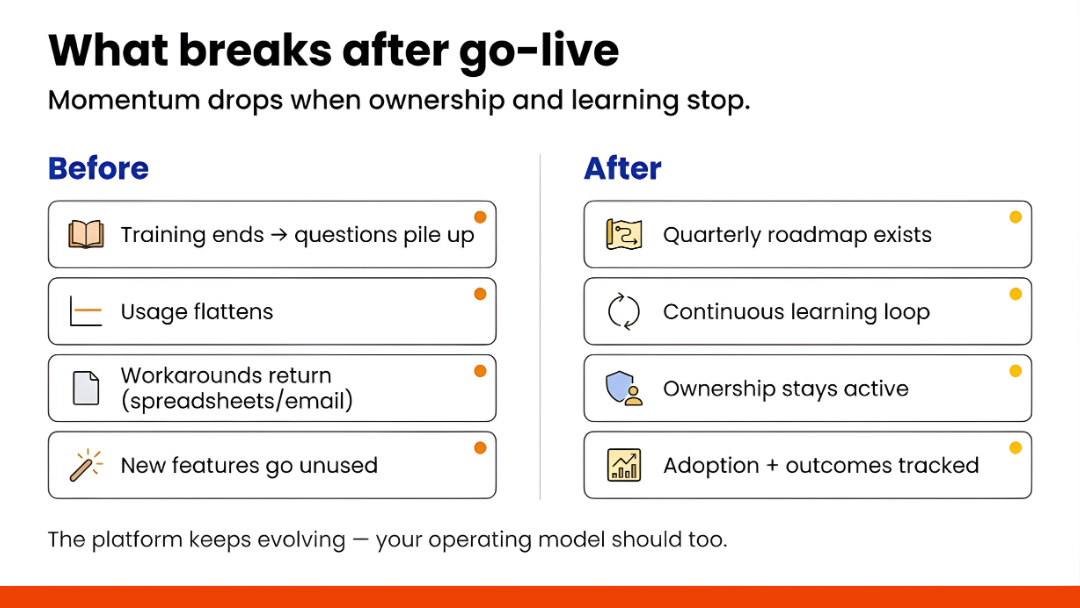
Before go-live, the risks are obvious: missed deadlines, poor testing, weak training, confused users. After go-live, the risks become quieter:
→ usage flattens
→ teams fall back to old workarounds
→ release notes are ignored
→ new features go unused
→ leadership stops checking whether business value is actually showing up
This is where change management becomes an ongoing business capability instead of a project workstream.
Modernization is not a finish line in the Microsoft ecosystem
One reason post-launch drift happens is that many organizations still treat modernization like a construction project: build it, hand over the keys, and close the file.
That mindset does not fit Microsoft platforms well. Dynamics 365 and Power Platform follow recurring release waves, and Power Platform environments receive these updates on a generally available deployment schedule twice a year. Microsoft also continues to publish wave content and change history updates as features are prepared and refined.
That means your operating reality keeps changing:
→ new features appear
→ governance controls mature
→ Copilot capabilities evolve
→ administration options improve
→ user expectations rise because the tools around them keep changing too
If your organization only funds the initial implementation and not the next layer of adoption and refinement, you leave value on the table. The software keeps improving, but your business does not benefit from those improvements unless somebody owns the next step.
Five practices that sustain modernization after launch
1. Track value, not just activity
Many teams report on activity because it is easy to count.
They track:
→ how many users were trained
→ how many tickets were closed
→ how many workflows were built
→ how many dashboards were published
Those numbers have a place, but they are not proof of impact.
A better post-launch scorecard asks:
→ Are cycle times actually falling?
→ Is rework down?
→ Are teams using the new process without side spreadsheets?
→ Is customer response quality improving?
→ Are managers making decisions with better data than before?
This is where change management and business ownership need to meet. If your adoption dashboard shows logins going up but business outcomes staying flat, that is a signal that the change has been introduced but not yet embedded.
For WordPress and Rank Math purposes, this also gives you a strong mid-article framework section, which search engines tend to reward when it answers a practical question clearly.
2. Build a quarterly innovation roadmap
Post-go-live teams often drift because nobody defines what comes next.
A better approach is to run modernization in quarterly cycles:
→ review business friction points
→ review release-wave updates from Microsoft
→ select a small number of high-value improvements
→ assign owners
→ define adoption and value measures
→ close the quarter with a review of what changed
This does two things. First, it prevents your team from treating every new feature as urgent. Second, it stops momentum from dying after the initial rollout.
For example, Q1 might focus on stabilizing ERP usage and improving reporting. Q2 might introduce Copilot-assisted workflows. Q3 might target approval bottlenecks through Power Automate. The point is not to chase every update. The point is to convert platform change into business change on purpose.
3. Keep learning continuous, not event-based
A one-time training push is rarely enough.
Microsoft’s own ecosystem direction makes that clear. New release-wave capabilities keep arriving, and organizations that want real value need a learning loop that keeps pace. ANZ’s public commentary on AI adoption is useful here. In 2025, the bank described AI adoption as an ongoing effort tied to regular use, experimentation, and continuous learning across its 45,000 employees, not as a one-off training event.
That is the right model for modernization more broadly.
Continuous learning can be practical:
→ short release briefings for managers
→ monthly “what changed” sessions
→ use-case based learning instead of generic product demos
→ office hours for users who need help in real scenarios
→ internal champions who convert platform updates into team-level guidance
This matters especially in service businesses, distributed operations, and regulated environments where process drift becomes expensive quickly.
4. Keep ownership alive after the project ends
One of the biggest reasons value stalls is that the project team disappears and nothing replaces it.
A better model is a small post-launch governance layer. Some organizations call this a modernization council. Others use a platform steering group or a Center of Excellence. The name matters less than the charter.
Its job is to answer four questions every quarter:
- What is changing in the platform?
- What is changing in the business?
- What friction is still present in the process?
- Where should we invest next for the highest return?
Power Platform governance and administration continue to evolve in the Microsoft release plans, which makes this kind of ownership even more important. New governance capabilities only matter if somebody is paying attention and deciding how to use them well.
5. Budget for optimization, not just implementation
This is where many modernization programs become financially self-defeating.
The capital budget covers the project. The operating model gets ignored. Then leadership wonders why benefits flatten after the first few months.
Continuous improvement needs a modest but deliberate budget line for:
→ adoption support
→ workflow refinement
→ reporting improvements
→ data-quality cleanup
→ release review and testing
→ limited pilot work for new features
The companies that get more from Microsoft investments are rarely the ones that buy the most technology. They are usually the ones that keep improving the operating model around what they already own.
A simple example: what sustaining momentum looks like in practice
Consider a services firm that moved to a cloud ERP and CRM stack last year.
A traditional approach would have ended at go-live:
→ implementation completed
→ support window closed
→ project team dispersed
→ new requests pushed into a backlog nobody actively governed
A better approach looks different.
The firm keeps a small improvement committee in place. Every quarter it reviews:
→ where teams are still using offline workarounds
→ which reports leaders still do not trust
→ what Microsoft has added in the latest release cycle
→ which manual tasks are now good candidates for automation
→ where managers need refresher training
In Q1, the team fixes approval bottlenecks and cleans up data fields.
In Q2, it adds AI-assisted summaries to reduce admin time for account managers.
In Q3, it refines dashboards so leadership can spot margin issues earlier.
In Q4, it tightens governance and retires duplicate spreadsheets.
That is not a dramatic transformation story. It is better than that. It is a realistic one.
A practical operating model for ongoing change management
If you want a simple way to operationalize this, use this five-part model:
1. Review
Assess platform changes, business priorities, user friction, and value metrics each quarter.
2. Prioritize
Choose a short list of improvements that are meaningful, not just technically interesting.
3. Enable
Prepare users with targeted learning, manager briefings, and updated process guidance.
4. Measure
Track business outcomes, user behavior, and support signals after each change.
5. Reinforce
Document wins, retire old workarounds, and decide what moves into the next quarter.
This is where change management becomes a steady business rhythm rather than a launch checklist.
Why this matters across ANZ, the US, and Canada
The pressure is different in each market, but the pattern is similar.
In the US, scale and speed make post-launch drift expensive. Large teams can revert to fragmented habits quickly if ownership is weak.
In Canada, distributed operations and governance expectations often make consistency more important than flashy rollout moments.
Across ANZ, organizations tend to be pragmatic about value. There is little patience for big transformation language if daily work does not improve. The strongest examples in the region, including ANZ’s public framing of AI adoption, emphasize continuous learning and real workflow use rather than announcement-level enthusiasm.
The underlying principle is universal. Customer expectations keep rising. Platform capability keeps evolving. Competition does not pause after your go-live date.
That is why continuous improvement ideas associated with kaizen still resonate globally: not because every company should copy Japanese manufacturing methods literally, but because the discipline of small, steady improvement scales better than one-off transformation theater. ASQ’s quality glossary still defines continuous improvement as an established management approach for improving processes over time.
Conclusion
Modernization should not end with implementation.
The more useful test is this: six months after go-live, is the organization still learning, improving, and getting more value from the platform than it did at launch?
That is the space where change management earns its keep. It helps organizations move from rollout thinking to operating-model thinking. It keeps attention on adoption after training ends, on value after dashboards are built, and on ownership after the project team has moved on.
Microsoft’s release cadence gives organizations a constant stream of new capability. But only disciplined teams turn that capability into business results.
The companies that do this well treat modernization as an always-on strategy. They review, prioritize, enable, measure, and reinforce. They do not wait for the next large project to improve how work gets done.
Osmosys can play that role with you not only at implementation, but after launch as well — helping you turn platform change into measurable business progress quarter after quarter.

FAQ
What is change management in digital transformation?
Change management in digital transformation is the structured work of helping people adopt, use, and sustain new ways of working. It goes beyond launch communication and training; it also covers reinforcement, leadership alignment, feedback loops, and adoption measurement. Prosci’s research continues to show that strong change management is closely linked to better project outcomes.
Why does modernization lose momentum after go-live?
Momentum often drops because ownership becomes unclear, learning stops, and teams focus on system stability rather than business value. When there is no post-launch roadmap, users tend to return to old habits and new platform capabilities stay underused.
How often should organizations review Microsoft platform changes?
A quarterly review rhythm works well for most organizations. That cadence is practical for evaluating release notes, user feedback, governance needs, and business priorities while staying aligned with Microsoft’s recurring release-wave model.
What should leaders measure after implementation?
Leaders should measure business outcomes, not only activity. Good post-launch measures include process cycle time, exception rates, user adoption in real workflows, reporting trust, service quality, and whether old workarounds are actually disappearing.
Is change management only for large enterprise projects?
No. Smaller implementations often need it just as much because lean teams feel disruption faster. Even a focused Dynamics 365, Power Platform, or ERP rollout benefits from clear communication, manager reinforcement, short learning loops, and visible ownership after go-live.

Osmosys Software Solutions